Home › Services
Wood privacy fences in Noblesville, built for clay and hard winters
A wood privacy fence is still the most requested backyard enclosure across Noblesville and the rest of Hamilton County, and for good reason: it blocks sightlines completely, it takes stain in any shade an association will approve, and a single damaged board can be swapped in minutes. It also asks more of its owner than any other material. Lumber grade, post size, fastener metal and a realistic staining schedule decide whether the boards stay flat for fifteen years or start cupping after the second winter. This page walks through cedar against treated pine, the main styles, how solid wood handles wind on open new lots, and the upkeep that keeps it standing. When you know what you want, send the address and a few photos.
Cedar or treated pine: what the choice really changes
Southern yellow pine treated with a waterborne preservative is the workhorse of Indiana backyards. It is strong, holds screws well, and resists the fungi and insects that chew through untreated softwood. The tradeoff is movement. Treated pine arrives wet from the plant, and as it dries it shrinks, twists and sometimes checks along the grain, so boards that looked tight on install day can show small gaps by fall.
Western red cedar takes a different route. Its heartwood carries natural oils that slow decay, it weighs less, and it moves far less as it dries, so pickets stay flatter and gaps stay more even. Left alone it weathers to soft silver. It is softer than pine, dents more easily, and costs more per board. A common compromise in Hamilton County is cedar pickets and rails on treated pine posts, which puts the rot-resistant chemistry where the wood touches dirt and the stable, good-looking wood where people actually see it.
The ground-contact stamp is the line that matters most
Not all treated lumber is treated to the same level. Every piece should carry an end tag or stamp naming its use category, and the difference between above-ground and ground-contact retention is the difference between a post that lasts and a post that goes soft at grade in a handful of seasons. Big-box racks often stock both side by side, and they look identical.
- Posts set in soil or concrete need a ground-contact rating, full stop. Above-ground stock is fine for pickets and rails but not for anything buried.
- Cut ends expose untreated heartwood. A brushed-on end-cut preservative over every trimmed post bottom is a small step that is easy to skip and costly to miss.
- Kiln-dried after treatment lumber costs a little more and arrives already shrunk, which means fewer surprises as the fence settles in.
Five wood privacy styles and how each one behaves
Style is not only a looks decision. Each layout changes how much wind the fence catches, how visible shrinkage gaps become, and how much stain it soaks up.
- Stockade: pickets butted edge to edge with pointed or dog-ear tops. It is the leanest use of lumber, but as treated pine dries, thin slivers of daylight appear between boards.
- Board-on-board: a front row of pickets with a back row covering the joints, so shrinkage never opens a see-through gap. It uses more wood and is heavier on the posts, and it looks finished from both yards.
- Shadowbox: pickets alternate sides of the rail with a deliberate space between them. Air moves through while straight-on views stay blocked, which makes it kinder to posts in an exposed yard. Viewed at a sharp angle it is not fully private.
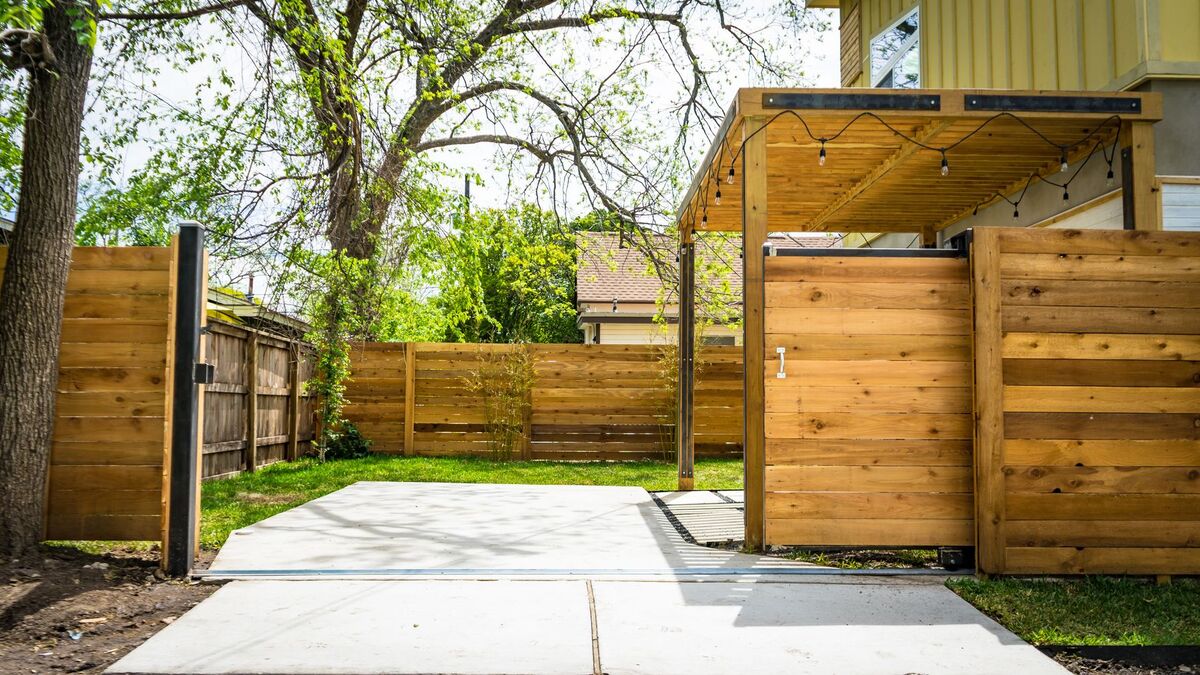
- Horizontal: the boards lie flat across the bays, which gives a cleaner, contemporary face. Stretched horizontal boards tend to droop without a center support or a stiff cap, so post spacing usually tightens and lumber quality matters more.
- Cap and trim: a flat cap board over the posts and pickets plus a trim strip below it. It sheds water off the end grain of every picket, stiffens the top line, and gives a framed, furniture-like finish many associations favor.
Post size and spacing for a fence with no gaps
A solid wood fence is effectively a sail held up by a row of posts. Four-by-four posts are common and adequate for shorter, more open layouts, but for tall solid styles many installers step up to six-by-six posts, especially at gate openings, corners and line ends. A heavier post resists twisting as the wood dries and gives screws more meat to bite. Spacing typically runs at or under eight feet between centers for a solid fence, and tighter for horizontal designs or heavy board-on-board.
Rails do the quiet work: three per tall section keep pickets from bowing mid-span. How deep each post sits, and in what backfill, belongs to the installation process; the fence installation page covers hole depth, concrete versus gravel, and how frost in central Indiana clay shapes that decision.
Wind on open subdivision lots puts real strain on a solid fence
Many newer neighborhoods around Noblesville were built on former farm ground, and the mature trees that would break up a westerly gust are years away. A tall wall of boards across a flat, open lot catches the full force of a summer storm line with nothing in front of it. That is the main reason privacy fences in young subdivisions lean sooner than ones tucked behind older tree cover.
There are honest ways to lower that load. Shadowbox and spaced-board styles let some air pass. Heavier posts on the windward side and a cap board tying the tops together both help. Where a fence must stay fully solid, spend the extra on posts rather than decorative upgrades. A section that has already leaned or snapped is a different conversation, handled on the fence repair page.
Fasteners: the small metal choice that stains or holds
Modern copper-based wood treatments are hard on plain steel. Bright or electroplated nails corrode inside treated pine, lose their grip, and bleed dark streaks down the face of each picket. Cedar has its own chemistry that reacts with bare iron and leaves black stains around every nail head.
- Hot-dipped galvanized fasteners are the baseline for treated lumber and for cedar.
- Stainless steel screws or ring-shank nails cost more and are the safest pick near pools, along wet back lines, and anywhere black streaking would bother you.
- Screws hold rails tighter as the wood shrinks; ring-shank nails install faster and resist pulling out better than smooth shanks.
A staining and sealing schedule that matches Indiana weather
Bare wood drinks rain and pushes it back out in sun. That cycle raises grain, splits picket ends and invites mildew. A penetrating stain slows the swing and can add years before boards need replacing.
- Let new treated pine dry out before the first coat. A simple test: sprinkle water on a board, and if it beads instead of soaking in, give it more weeks. Cedar and kiln-dried lumber are ready sooner.
- Clean before coating. A wood cleaner or a light wash removes mill glaze, dust and early mildew so the stain can bite.
- Pick a penetrating, semi-transparent or solid oil or water-based stain rather than a film-forming paint. Film finishes peel as the wood moves, and scraping a whole fence is miserable.
- Coat both faces when the neighbor allows it, and do not forget picket tops and rail edges where water sits longest.
- Plan to recoat on a cycle of a few years, sooner on the south and west faces that bake in afternoon sun. When the water test shows soaking again, it is time.
How freeze and thaw break wood down, and how to slow it
Water that wicks into end grain freezes, expands, and pries the fibers apart from inside. Over a central Indiana winter that can happen dozens of times as temperatures swing around freezing. The damage shows up first where moisture lingers: picket bottoms sitting in mulch or snow, the tops of posts left flat and unprotected, and rail ends tucked into post notches where water collects.
Several details push that damage back. Keep picket bottoms a couple of inches above soil and mulch so they dry between rains. Use post caps or angle-cut post tops so water runs off. A cap board shields the top end grain of every picket at once. Trim shrubs and vines that hold moisture against the boards, and aim sprinkler heads away from the fence line.
Association rules and which side faces the neighbor
Most Hamilton County subdivisions have a covenant or architectural committee that speaks directly to wood fences. Common rules spell out allowed heights, whether privacy styles are permitted at all, how far a fence may come forward relative to the house, which stain colors are approved, and whether the finished side has to face outward toward the street and neighbors. That last rule surprises people: the smooth, picket face goes out, and the owner looks at rails and posts from inside the yard. Board-on-board and shadowbox styles soften that because they look good from both sides.
Get written approval from the association before any lumber is ordered; a rejection after delivery is an expensive lesson. Cities and towns may also ask for a permit, so check with the one that serves your address. Neighborhood-by-neighborhood notes live on the areas we cover page.
What moves the price of a wood privacy fence
Nobody can price a fence honestly from a phone description. The contractor sets a figure after walking the line, but the drivers are predictable, and knowing them makes quotes easier to compare.
- Species and grade: cedar over pine, and clear or select boards over knotty common grade.
- Style: board-on-board and shadowbox use more pickets per section than stockade; cap and trim adds lumber and labor.
- Total footage and the number of corners, ends and gates, since each one needs a heavier post and more hardware.
- Ground conditions: slope, roots, buried rock, wet clay and how close equipment can get to the line.
- Removal and haul-away of an old fence, plus any stain applied before the crew leaves.
Reading a wood fence proposal line by line
A proposal worth signing names the lumber species and treatment category, post dimensions and spacing, the number of rails per section, the fastener type, the gate widths and hardware, who handles utility locates and association paperwork, and how workmanship coverage is described. If a quote is just a footage figure and a total, ask for the details in writing. A comparison of wood against low-upkeep options lives on the vinyl fence page.
Ready to get a contractor out to look at the yard? Start on the contact page with the address, a rough sketch of where the fence would run, and a few phone photos of the line.
Wood privacy fences in Noblesville — common questions
Is cedar worth the extra cost over pressure treated pine for a privacy fence?
It depends on what bothers you more. Cedar stays flatter as it dries, resists rot naturally, and looks finished with very little effort, so it suits owners who notice gaps and cupping. Treated pine is harder, cheaper per board and very durable in the ground, but it shrinks and can twist during its first year. Many owners split the difference with treated pine posts and cedar pickets and rails. If your association requires a stained finish anyway, the appearance gap between the two narrows.
How long should I wait to stain a new pressure treated fence?
Treated pine usually leaves the plant soaked with water from the treating process, and stain cannot penetrate wood that is already full. Waiting a few months through warm, dry weather is typical, though timing varies with the season the fence went in and how much sun it gets. Sprinkle water on a board: if it beads, wait longer; if it darkens and soaks in within a minute, the wood is ready. Kiln-dried after treatment lumber can often be stained much sooner.
Why are black streaks running down my wood fence boards?
Those streaks are usually a chemical reaction between the wood and the fasteners. Cedar contains natural extractives that turn black when they meet bare or poorly coated steel, and modern copper-based treatments in pine corrode cheap nails, which then bleed rust down the face. Cleaning products made with oxalic acid can lighten the marks, but they return if the fasteners stay. Galvanized or stainless fasteners prevent the problem from the start, so it is worth checking what a proposal specifies.
Which side of a wood privacy fence has to face my neighbor?
Many Hamilton County associations require the finished face, the side where you see pickets rather than rails and posts, to face outward toward neighbors and the street. Some towns have similar expectations. Read your covenants before choosing a style, because if the rule applies you will be looking at the framing from your own yard. Board-on-board and shadowbox designs largely solve that, since they look complete from either side, which is one reason they are popular in neighborhoods with strict review boards.
Does a shadowbox fence give real privacy?
From straight on, yes. The overlapping pickets on alternating sides of the rail block direct views into the yard. From a sharp angle, someone walking along the fence line can catch glimpses between boards, so it is a little less private than solid board-on-board. The upside is airflow. Wind passes through the gaps instead of pushing against a flat wall, which takes strain off the posts, and the fence dries faster after rain, which slows mildew and rot.
How can I tell if my old wood fence posts are rotting below ground?
Push on the fence near each post and watch the base: a post that rocks or flexes at grade while the section above stays straight has usually softened just below the soil line. Probe the wood right where it meets dirt or concrete with a screwdriver; healthy treated wood resists, while rotted wood lets the tip sink in. Mushrooms, dark wet patches and ant activity near the base are also warnings. Since rot hides underground, checking a few posts along each run tells you more than inspecting just one.
Talk through your site
Start with the address, what you want done, and a few photographs of the area, including anywhere water sits after a heavy rain.
Related work
Fence Installation
New fences planned around Hamilton County association rules, central Indiana clay and deep winter frost.
Fence Repair
Leaning and heaved posts, sagging gates, wind damage and rot, and when to stop repairing.
Vinyl Fences
Vinyl privacy, semi-privacy and picket fences, and the quality differences that show up after a few winters.
Chain Link Fences
Galvanized and black-coated chain link for dogs, kids and back property lines.
Aluminum & Ornamental Fences
Ornamental aluminum for pools, front yards and neighborhoods with open-style fence rules.
Across the metro
Fishers
Dense subdivisions with strict association fence rules, pools and lots backing to common areas.
Carmel
Established neighborhoods and newer luxury homes where style rules and front-yard looks matter.
Westfield
Fast-growing west-side builds on freshly graded lots with slow-draining clay.
Cicero
Lake-area lots around Morse Reservoir and rural acreage with long runs and wet ground.